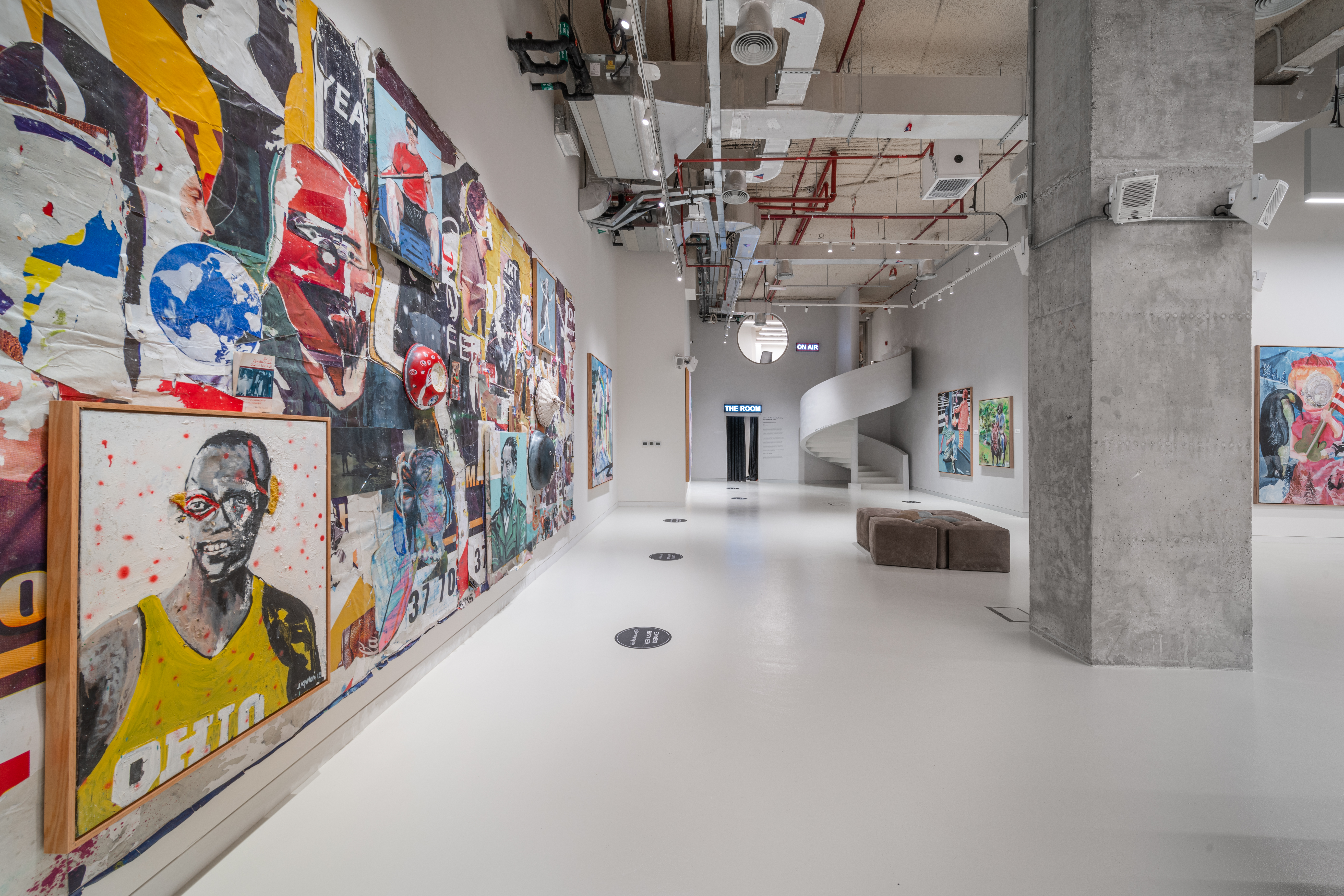
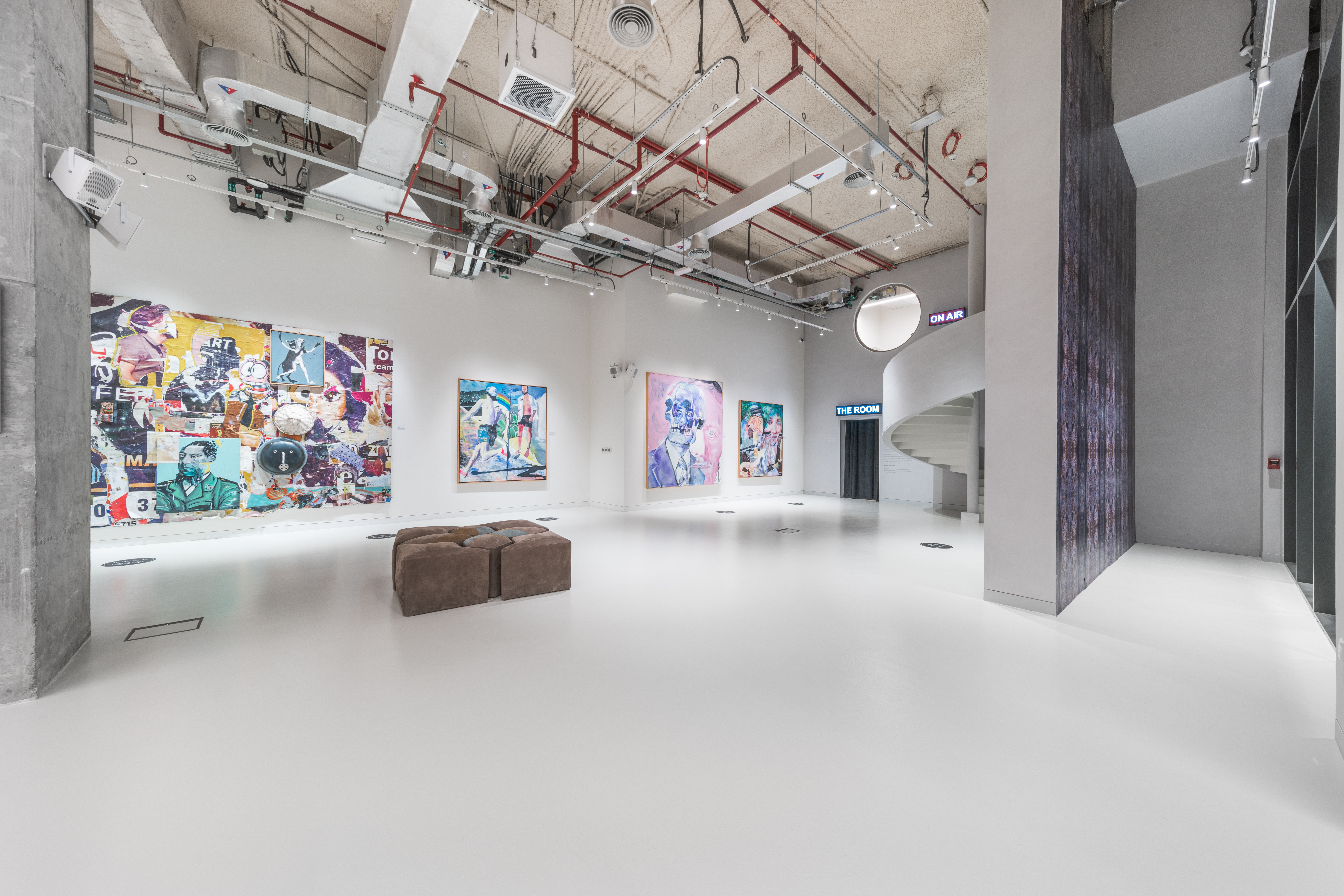
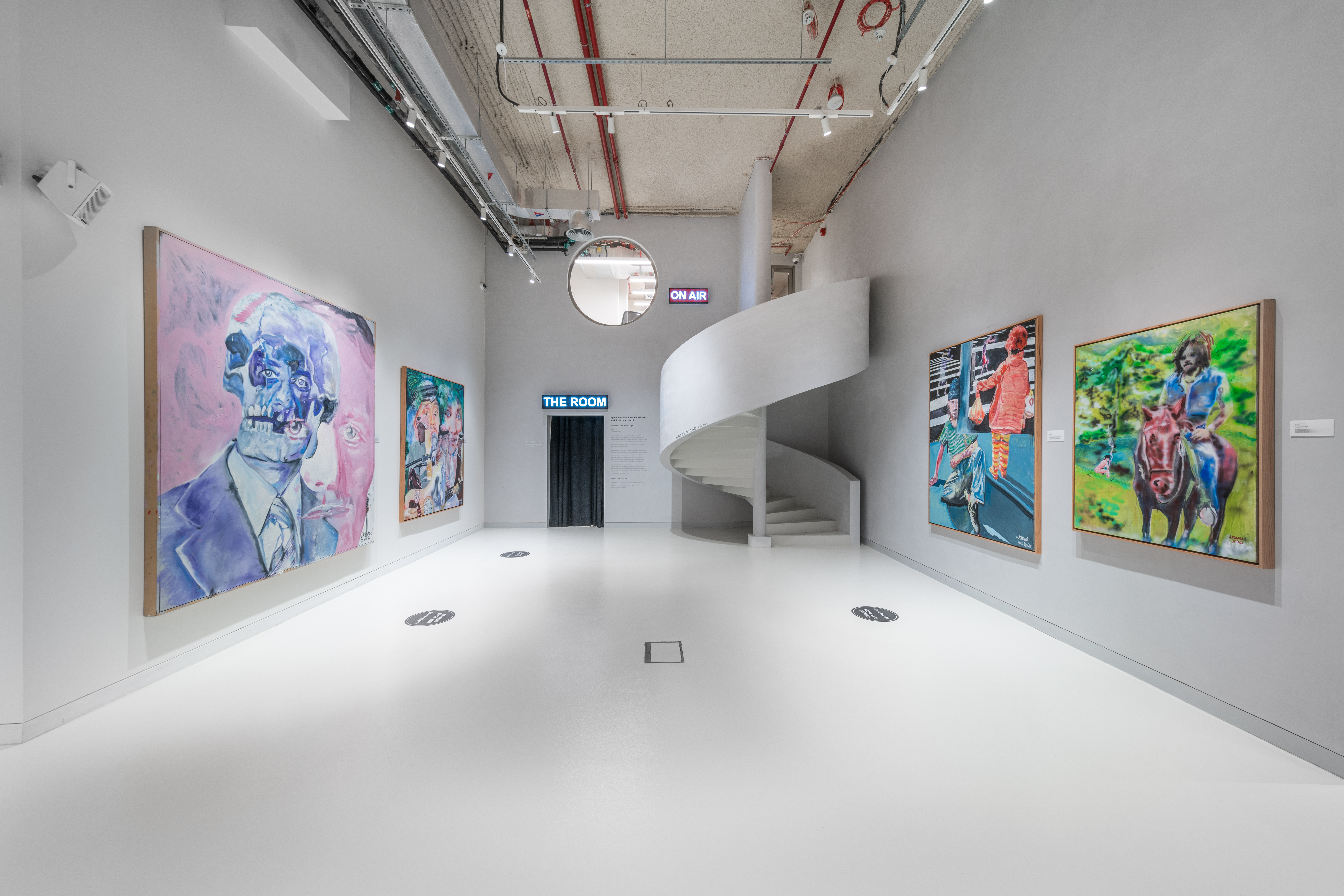
The stars in Utah’s Moab Desert, Lenny Kravitz’s lush Brazilian home, African traditions and remnants of Beirut all feature in the artist’s visual narratives. In the manner of collage, Khaldi disrupts perspectival planes and repurposes previous artwork by integrating new layers. The only collage in the exhibition – the manga-like Long – is sourced from weathered billboards in Beirut’s Hamra street, which were ripped apart and restructured on the floor of his Dubai studio. Elements of older paintings were incorporated, as well as the lid of a barbecue grill. This approach of juxtaposing different times and materials as fantasies and objects draw out a complicated image. Let it Go, for instance, fragments the face of a battery-operated, blinking, guitar-playing doll Khaldi came across in Beirut’s trinket-rich Sunday Market (Souk al-Ahad) with a pie (on aluminum plate). A downcast penguin and boxer are positioned in the foreground, disconnected from the mountainous backdrop of snowy pines. In Out of the Woods, animated electric-blue ghosts multiply above a diver’s disembodied head in a tropical paradise where a man floats face down, and another has just saved an orangutan (true story).
Khaldi acts on an impulse not to leave out any negative space, assembling his threads as vignettes for dense compositions. While his memories of Beirut, where he lived with his Palestinian parents until he was 16, are still present, he connects other places and cultural forms he has encountered since he moved to Sharjah from Texas in 1995. Constantly attempting to start over and reinvent himself, his art mirrors the ruptures and changes in his life. As a teenager in war-torn Beirut, he frequented the hedonistic music scenes and adult cinemas. As a university student of interior architecture in Dallas, he became an underground graffiti artist subject to precarious conditions and finally decided to leave when his studio burned down. In the UAE, he became one of the early instigators of Al Quoz’s now-cultural warehouse district, where he established the B21 gallery space in 2005.
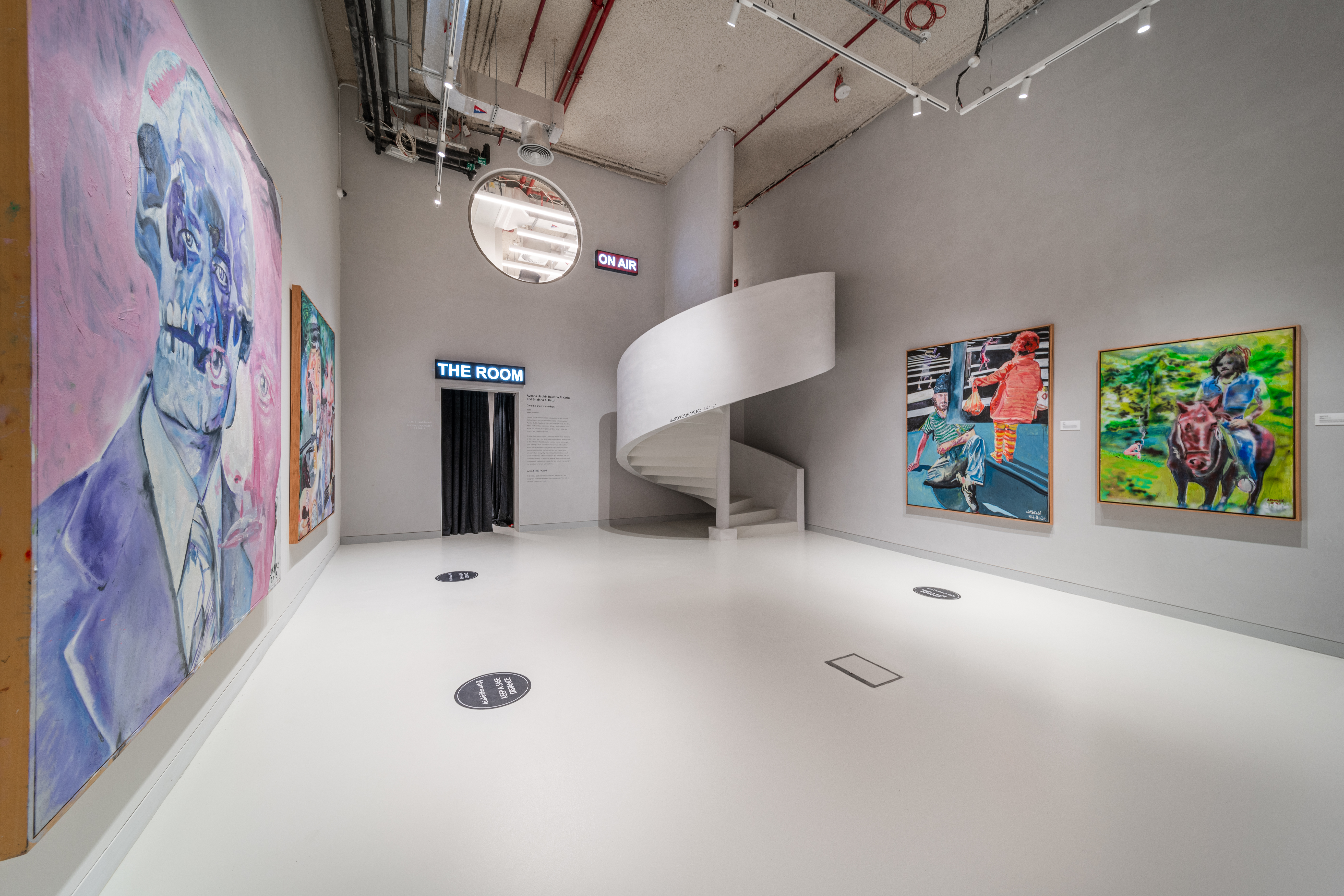
Khaldi believes it is the artist’s role to both envisage and document our contemporary conditions, but the references to Middle Eastern geopolitics and mediated violence have played a more indirect part over the years. His paintings are gestural and dynamic, yet figurative and saturated representations as he moves between the real and the illusory – with some social commentary. In Skid Row, a homeless man on in downtown LA leans against a frame dividing two acrobatic silhouettes while a clown watches (back to the viewer), carrying a plastic bag. Other works are more discreetly imbued with meaning: a thin tree separates the image of a runner, and a ruptured rainbow, from a bare-chested man (Open Shirt).
Intersecting histories are laid out but not all of Khaldi’s works call for an unpacking. Take his homage to the Gulf and its oral traditions with the legendary Saudi singer Mohamed Abdo (Cultural Heritage). Here’s a purely unadulterated vision – an image of gathering around music and its enchantment.